

 Duration – 4 Days
 Awarding Body – Highfield


Security Officer Course
Including Emergency First Aid at Work
All people who want to operate in the private security sector must complete a recognised qualification before applying for a licence, according to the Private Security Industry Authority Act of 2001.
The skills and information required for those who intend to apply for a SIA licence and work as a security officer are provided by this course, which has been designed to satisfy the standards of the Security Industry Authority (SIA).
All people who want to operate in the private security sector must complete a recognised qualification before applying for a licence, according to the Private Security Industry Authority Act of 2001.
To satisfy the demands of the Security Industry Authority, the HABC Level 2 Award for Working as a Security Guard within the Private Security Industry (QCF) was created (SIA). It offers the necessary skills and information for learners who intend to apply for the SIA Licence and is based on the pertinent SIA Specifications for Learning and Qualifications.
Work In All Environments

Retail

Contruction

Corporate

Warehouse

Other
No Hidden Costs

Course Fees

Study guide

e-learning platform

Practice Test

Assessments

Registration & Certification
Develop New Skills

Communication
Being confident and assertive is essential when communicating information and directions. Develop your skills communicating with different people. Different situations require different styles of communication. Building rapport is a key skill when working in the private security industry.
Arrest Procedures
Arrests are necessary for the investigation and prosecution of crime. Know when to perform arrests and how to apply the correct arrest procedure to ensure your, and the suspects safety.


Emergency Procedures
Develop your skills for identifying and responding quickly to emergency situations. This includes medical incidents, fires. Help people to safety by performing emergency evacuation procedures.
Terrorism
Know the signs and be alert. Security operatives are the first line of defence against terrorist activity. Identify suspicious behaviour early and know what action to take to save lives.


Search Procedures
Learn how to gain consent and perform searches. Effective search techniques are essential to screen people entering venues. This will allow you to identify prohibited items to ensure venues are safe.
Patrol Processes
Develop best practice for patrolling. Understand the different types of patrols. Learn how to conduct patrols safely. Know what to do if you identify suspicious activity.


Conflict Management
Prevent conflict from escalating into violence using communication. Learn how to apply conflict management techniques to cool heads and remove the possibility of violence.
Learn your way

Blended
Save on travel time and costs. Learn the theory during live online classes followed by a 1 day practical workshop

Classroom
Prefer face to face? We also offer a 4 day face-to-face class
Learning Journey
Book Course
This is timeline description. Please click here to change this description.
Complete First Aid or Emergency First Aid at Work
Learners must have a valid first aid certificate prior to attending the door supervisor course.
Complete Digital Training
This is timeline description. Please click here to change this description.
Attend Class
This is timeline description. Please click here to change this description.
Pass Multiple Choice Tests
This is timeline description. Please click here to change this description.
Pass Practical Assessment Workshop
This is Timeline description, you can change me anytime click here
Apply for SIA Licence
This is Timeline description, you can change me anytime click here
Learning Outcomes
- Principles of Working in The Private Security Industry
- Principles of Working as a Security Officer in the Private Security Industry
- Application of Conflict Management in the Workplace
1. Know the main characteristics and purposes of the private security industry
2. Understand legislation as it applies to a security operative
3. Understand arrest procedures relevant to security operatives
4. Understand the importance of safe working practices
5. Understand fire procedures in the workplace
6. Understand emergencies and the importance of emergency procedures
7. Understand how to communicate effectively as a security operative
8. Understand record-keeping relevant to the role of the security operative
9. Understand terror threats and the role of the security operative in the event of a threat
10. Understand how to keep vulnerable people safe
11. Understand good practice for post-incident management
| 1. Understand the roles and responsibilities of security officers 2. Understand the control of access and egress 3. Know the different types of electronic and physical protection systems in the security environment 4. Know how to minimise risk to personal safety at work 5. Understand drug-misuse legislation, issues and procedures relevant to the role of a security officer 6. Know how to conduct effective search procedures 7. Understand how to patrol designated areas safely |
1. Understand the principles of conflict management appropriate to the role
2. Understand how to recognise, assess and reduce risk in conflict situations
3. Understand the use of problem-solving techniques when resolving conflict
4. Be able to communicate to de-escalate conflict
Lorem ipsum dolor sit amet, consectetur adipiscing elit. Ut elit tellus, luctus nec ullamcorper mattis, pulvinar dapibus leo.
Entry Requirements
 Qualifications |
| First Aid Learners will need to show that they hold a current and valid First Aid or Emergency First Aid certificate. It is an SIA requirement that training centres must confirm that each learner is sufficiently qualified in First Aid or Emergency First Aid. Learners should present their certificates before they start training. This certificate must be valid for at least 12 months from the course start date. If you do not have a first aid qualification you can book it online by visiting our first aid training section. You can book both qualifications at the same time |
 Work Experience |
| No formal work experience is required |
 Required Documents |
| We require a number of supporting documents at the application stage, including: |
 Language Requirements |
| It is essential that security officers are able to communicate clearly and effectively. As an entry requirement for this course, all learners must have sufficient reading, writing, speaking and listening language skills. |
 Other Requirements |
| Learners must be aged 18 years old + Blended Learning Learners must have access to a computer/tablet with stable internet connection Learners must have access to a quiet location free from distraction to join the class |
Assessment
 | Multiple Choice Exams |
 | Practical Assessments |
Unit 1 – Principles of Working in the Private Security Industry
 |  |  |
| 72 Questions | 110 Minutes | 70% Pass Grade |
Unit 2 – Principles of Working as a Security Guard in the Private Security Industry
| | |
| 60 Questions | 90 Minutes | 70% Pass Grade |
Unit 3 – Application of Conflict Management in Private Security Industry
| | |
| 20 Questions | 30 Minutes | 70% Pass Grade |
Progression
After successful completion of this course, you could progress on to

Door Supervisor
Widen your appeal to employers and enable yourself to provide security services in licensed premises such as pubs, nighclubs, and casinos. Door Supervisors can earn £15+

CCTV
Operate public space CCTV systems in cities, stadiums, corporate and retail settings.
Boost your salary with tis extra skill set

Close Protection
Deliver executive close protection services to VIP’s, celebrities, politicians and business leaders
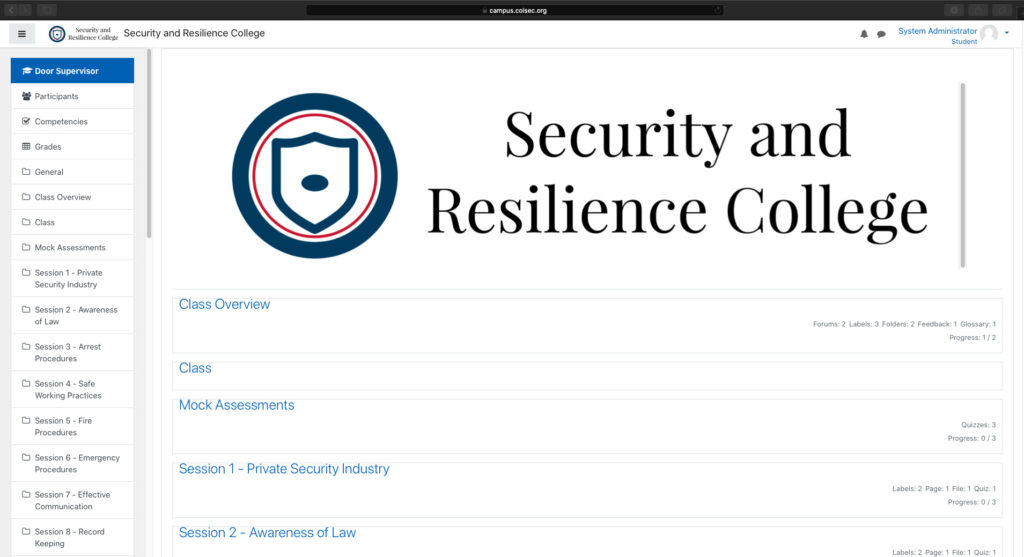
Digital Learning Platform
You can access our innovative learning platform on any device. At home, in the office, or on the move. This supports both virtual and classroom delivery models
Expert Instructors
Learn from the best in the industry with our security course led by expert instructors. Our seasoned professionals bring a wealth of real-world experience, ensuring you receive practical insights and hands-on training. Gain invaluable knowledge from instructors who are dedicated to equipping you with the skills needed for a successful career in security.

Payment Options


Card Payment
Pay direct with your debt or credit card

Klarna
Klarna allows flexible payment options to break your course fees into monthly instalments. Select the Klarna payment option in checkout.

Paypal

Locations


